

What Will Tomorrow Bring?
October 13, 2026
The Cape County Historical Society (CCHS) began on a hot, Monday afternoon, August 9, 1926, when approximately 20 people showed up in the Circuit Courtroom of the Courthouse in Jackson. Some were responding to personal invitations and others came because of a letter that appeared in the Southeast Missourian on July 14, 1926, appealing to the paper to use its circulation and connection with other local papers to post the letter. The letter, written by Robert Burnett Oliver was a plea to anyone wishing to help form a Cape County Historical Society. He cited the importance of knowledge of the county’s history was being lost as older resident’s were passing. He mentioned he was the only surviving member of his father’s family. His plea worked; 17 signatures appear on the hand-written minute of the first meeting. A few signatures were both husband and wife. Those who came to the meeting became the Charter Members of the Society.
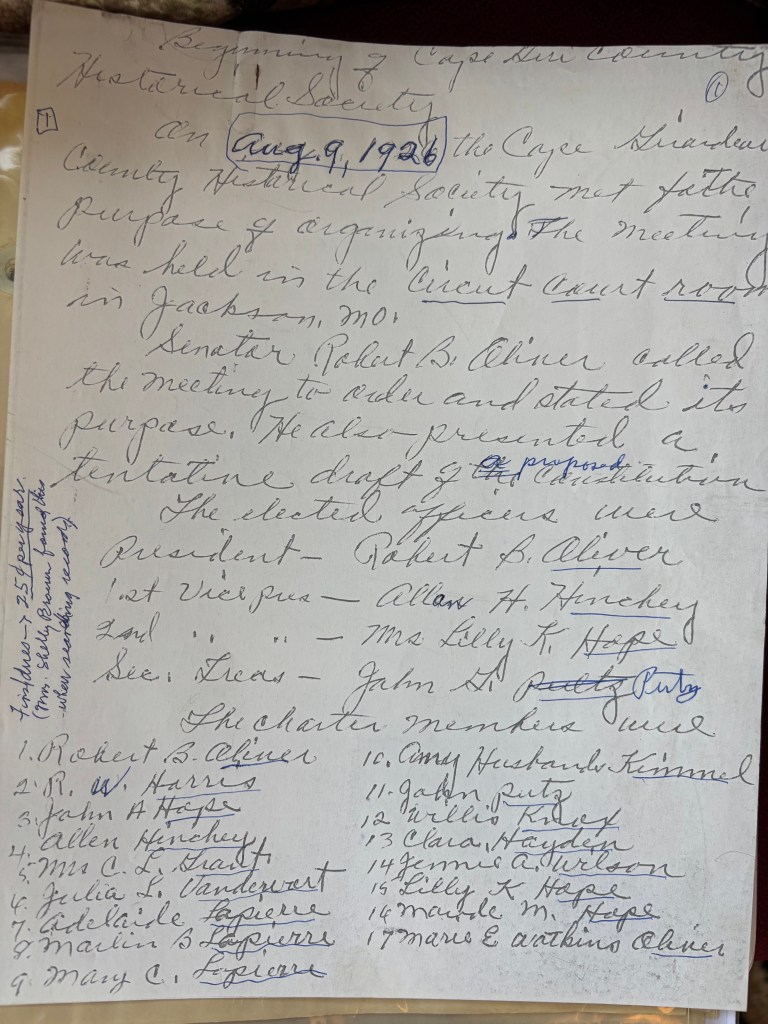
The group got to work quickly selecting officers and creating a constitution which was published in the State Historical Society’s magazine. Officers voted into office were:
President: R. B. Oliver
Vice President: Allen H. Hinchey
2nd VP: Mrs. D.C. Hope
Secretary/Treasurer: John Putz
People wanting to become members had to apply for membership and be voted in by majority vote. Membership was free at the time. The mission of the society was listed as to “secure, rescue and preserve collections of elderly and well-informed persons concerning the history of Cape County.” Meetings would be held monthly, with an annual banquet in August. The lack of a permanent place to meet led to the meetings rotating from the county courthouse, Cape high school, SEMO Teachers College, the Cape Public Library, eventually settling on a rotation between the Carnegie Library (Public) in Cape and the courthouse in Jackson. Each member was required to collect, research and give a presentation on various topics in the county. Documents would be collected and archived. The question is where, since the society had no permanent location.
As the decade of the 1930’s arrived, the society decided on an annual due of .25 cents per person. At the 1936 banquet the guest speaker was Floyd Shoemaker, secretary of the State Historical Society. This visit established a long-lasting relationship between the CCHS and the State Historical Society. By the end of the decade the historical society had lost 3 key members; R.B. Oliver, Allen Hinchey and Judge John Kochtitzky.
The 1940’s brought more challenges. The Great Depression continued and World War II began and ended. The society had struggled to meet monthly so they decided to move to quarterly meetings. By 1948 it was noted the society had archived 450 manuscripts.
The 1950’s brought major changes to the historical society and the county. Unfortunately, minutes do not exist between 1950 and 1955. The last half of the decade saw a plan to secure 3,000 acres for a proposed state park, Trail of Tears, recognizing the trail of the removal of what was known as the 5 Civilized Tribes from the southeastern United States to what is now the state of Oklahoma.
The late 1950’s saw increased attendance and involvement in the society. The society changed their meetings to Saturday afternoon in hopes of gaining attendance of students and teachers instead of their weekday meetings in 1959. In 1960 Mrs. Arthur W. Thilenius was elected president. She brought a new kind of energy to the society, more public exposure. The search for a place for a permanent museum began. The by-laws and constitution were amended. Membership dues changed to $1 for annual and $25 for lifetime. Officers would now serve two years. Meetings remained quarterly (January, March, June and September). A permanent meeting place was found at the Jackson Public Library. In 1961 the society voted unanimously to accept a donation from the Clyde A. Vandivort family of 19 acres at Burfordville, which contained the mill. When Mrs. Thelenius completed her term in 1962 the society had negotiated a room at the Common Pleas Courthouse in Cape for a museum, inherited the Bollinger Mill and a membership of 500 plus members. The membership would swell to 585 members by the mid 1960’s. In 1966 the CCHS transferred ownership of the Mill to the Cape County Court and eventually the court would transfer the Bollinger Mill to the State Park Commission. The covered bridge, which was not part of the gift, remained under the State Highway Commission. The society would remain involved with work on the Mill and the Bridge restoration, though limited by ownership of the state. The growth of the late 50’s and early 60’s saw the exact opposite by the late 60’s and early 70’s. By the late 60’s the city of Cape had the Greater Cape Girardeau Historical Society which had been gifted the Glenn House. Jackson had formed a city historical society.
As the 1970’s emerged it appears the CCHS began to have an identity crisis. Membership dropped off dramatically. A decision was made to move the annual banquet from Fall to Spring. Changing the banquet meeting seemed to happen almost every decade. While still collecting information about the larger cities of Jackson and Cape, they decided to focus their efforts more on the rural communities and assist other historical organizations that were being formed. The Burfordville Mill was nominated for the National Register of Historic Places in 1970 because the mill, dam and bridge were the only combination of its kind in existence. In 1973 the Common Pleas courthouse needed more room, so the society had to close and move the museum into storage. The topic of disbanding the CCHS came up in the 1970’s, but a discussion was all that happened. The historical society pushed forward with membership well below 100 and no museum. At the annual banquet in 1979 Rush Limbaugh, President Emeritus State Historical Society of Missouri was the guest speaker. His topic was “Forgotten History of Cape Girardeau County”. It was a fitting topic for what would become a mystery for the present-day members of the society as to what happened to many of those early collected documents. The minutes of 1974-1979 are missing.
The society would struggle with the identity crisis which began in the early 1970’s until the 2000’s. The 1980’s saw meetings per year reduced from 4 to 3. The minutes were another issue, many are missing. The annual banquet was moved from the Fall to the Spring, leaving January as the business meeting and September a trip to a historic site in Southeast Missouri. By the end of the decade meetings were reduced to 2 per year. The annual banquet in the Spring and a Fall Historic Site trip.
One could say the 1990’s was a quiet period. The meetings seemed to stabilize, with a Spring Banquet and a Fall Trip. Attendance varied between 10 to 60 as the society followed through with electing officers. Zion Lutheran church at Gordonville hosted the annual banquets during the decade.
The turn of the century saw a dramatic change to the historical society. The first 3 years saw little change in meeting places. The annual banquet moved from April to May. A special meeting of the Executive Board was held in October to discuss the Mildred Brown Trust which had been established for the historical society. The creators of the trust, Shelby and Mildred Brown, had been long-time members of the society and officers on the Executive Board. Receiving the Brown Trust had a dramatic change on the society. Over the next 12 years the Trust would be the center focus of discussion at almost every meeting. In 2006 at a special business meeting a discussion on how to best serve the Trust’s purpose was brought up to make a donation to a proposed Civic Center to be built in Jackson. In 2007 the annual dues were raised from $2 per person to $5 per person.
In 2010 the Fall outing became a second meeting. Updates on the Civic Center’s progress had become an annual discussion. A meeting in 2012 discussed the historical society receiving 1,300 square feet for a museum in the new Civic Center. It was never voted on by the society. In 2013 the city announced the public library would be closing. The society would move its collection of historical documents to the Riverside Regional Library. That Fall the city of Jackson offered additional storage space to store more documents. At the September 2014 meeting it was announced a place had been found for a History Center at 102 S. High Street. Along with a new location, Carla Jordon was introduced as the new Director who would work 3 days per week. At the same meeting a motion was made and carried to rescind in its entirety, the promise of a large sum of money to the SEMO Medical Center, the driving force behind the Civic Center. President Boren assured the society that no part of the promised money had ever been given to the project. It had only been a pledge. In 2015 more changes occurred as remodeling the newly acquired location got started. Attendance was on the rise and the annual banquet was moved from the Spring to the Fall, where it has remained. Through the end of the decade attendance remained above 50 people, membership grew to over 100, new committees were formed as well as an active docent team.
The current decade opened with two issues, the acquisition of a second building at 110 S. High Street to house a Research Annex and the Covid Pandemic. Because of Covid, no meetings were held during 2020 and 2021. The April 2022 meeting gave membership updates on the 2 previous years. Membership had passed 150 with 55 active docents and 400 donor artifacts had been processed. Despite Covid a dedicated, small group of individuals worked on moving the historical documents from storage into the new Research Annex and organizing them along with a large book collection for researchers to use. December 2024 saw changes to the constitution. The following year, 2025, saw a significant increase in membership and donations. Public awareness increased with continued involvement with the city of Jackson and the county by offering tours, the first ever Antique Evaluation, a growing Arts and Craft show, changing exhibits and continued growth in donations. Over the past 100 years over 22, 600 collections, papers and artifacts have been accessioned. The year 2026 has witnessed continued expansion in collections, donations, and public visibility which will culminate in our 100th anniversary on August 9 this year.
The Cape County Historical Society is questionably the oldest continuous operating historical society in the state of Missouri. Historical Societies survive like any business, by adapting to the times. While the 70’s, 80’s and 90’s seemed like decades of no growth, the few members and officers continued to adapt, collect and preserve the history of Cape County. The core idea of preserving Cape County History has not changed from that first meeting 100 years ago. It is still to collect, preserve and document the history of Cape County.
What will the future bring? Hopefully the historical society will continue accomplishing the mission of documenting, preserving, and interpreting the history of yesterday, today and tomorrow in Cape Girardeau County. This can be accomplished by developing a stronger system to document and publish the stories of the people, places, and material culture of the region. A large dream is to establish a Military History Wing for better stewardship of regional military history by partnering with the other Military sites and collections in the region. The Society hopes to continue to grow its existing educational relationships with the Historic Preservation Program at SEMO and other public and private schools. Continuing to support and promote regional historic sites and research libraries growth is a continuing goal. Thinking about the future of the CCHS current members can identify with those people who met 100 years ago.
David Dickey, Executive Board Vice President
Gallery

We receive so many wonderful photos at the Cape Girardeau County Historical Society that we decided to begin sharing them with the public and asking for help identifying people, places and dates. It is so important to label your photos with this information. The first photo we are sharing is very timely as it shows the group of men who built the original fountain in front of the Cape Girardeau County Courthouse, which is in the process of being renovated right now. The people who have been identified are Cecil Brotherton-bottom row, far left, Harvey Brotherton-bottom row, third from left, and Elbert Masters, top right. Thanks to the Brotherton family for the donation.
If you can identify any of the other people in the photo, please contact us by email or phone. Thanks for your help and remember-Label Your Family Photos!
Alice Ireland, Executive Board Librarian
March 15, 2025
Here’s What Happens at the Research Annex!
April 24, 2024


In case you ever wondered what goes on at the Research Annex for the Cape Girardeau County History center, these three incredible volunteers can tell you. They come in every Tuesday each week and process collections, scan photos, file small manuscripts and anything else we need them to do. It is people like these three who are preserving the history of Cape Girardeau County.
Alice Ireland, Executive Board Librarian
Books! Books! Books!
February 19, 2024

We are often asked what we will take as donations at the Cape Girardeau County Historical Society. Cash is always appreciated and very much needed. Our mission is to document, preserve and interpret the regional history of the people, places, things, and events from yesterday, today and tomorrow. Therefore, we like to receive as donations photographs, documents, books and artifacts that tell the story of Cape Girardeau County.
Let’s talk about books. We do not take fiction books. Those should go to the public libraries in the area. We do take the following books: regional, state and national history; family genealogy; yearbooks for area schools; church histories; presidential history; military history; and Native American and African American history.
We have a nice selection of family genealogy books but are always looking to expand that section of our library. We also have a large selection of area school yearbooks. However, we are missing several years from our collection. The annuals that we do not have include Jackson Silver Arrows from 1916-1920, 1926, 1931-1935, 1973 and 1978. We are also missing these years for the Cape Central Girardot: 1925-1932, 1940-1947, 1953-55, and 1960-1963. Southeast Missouri State Sagamores that are needed include 1918, 1945, 1946, 1949, 1950, 1952, 1958-1961. We would very much appreciate having any of these yearbooks.
As you think about cleaning out closets and basements this spring, please consider the Cape Girardeau County Historical Society as the place to donate books, photographs, documents and artifacts that tell your story. Thank you!
Alice Ireland, President, Cape Girardeau County Historical Society
History Matters

September 3, 2023
I hope you all have fun plans for this Labor Day weekend.
We have plenty of upcoming plans I hope you will participate in this Autumn. Our banquet tickets for our annual event are on sale. The event will be Sunday, November 5, at 6 p.m. at the Jackson Civic Center, 381 E. Deerwood Dr., Jackson, MO. We have planned as our theme a “Celebration of Santa Claus.” Our guest keynote speaker is Dr. Henry Wolf, a renowned Santa Claus expert. Tractor’s catering will be creating “Grandma’s Christmas Feast” for us, and the regional band, Docsology, will perform a concert. We have organized a special Santa-themed silent auction. Tickets are $60 each, and can be purchased at the History Center at 102 S. High St., or send a check to this address and we will mail them to you. For more info. call: 573-204-4240.

Another Autumn fun event is the next in our Speaker’s Events: The History of Beekeeping in Southeast Missouri with Carmen McNeely of Indian Creek Hives. Sunday, October 15, from 2-4 p.m. at the History Center, 102 S. High St., Jackson. Admission is free, and refreshments will be served.

I hope you can join us for one of these special events. Take care, Director Carla
History Matters
August 12, 2023
One of the “sayings” I use for docent museum volunteer and university student development is, “Everything from neurosurgery to belly dancing is about relationships.” One of my dear pals is a neurosurgeon and I long have been enamored of belly dancing, but only in the past few years have I known an accomplished belly dancer—my beloved friend and MoMo’s Bakery owner, Shannon Stafford. The point of my “saying” is to promote forward progress in our mission, to promote personal (and professional growth) as well as promoting joy from positive relationships. We create an environment of stability and growth at the History Center with a focus on kind but direct interactions, encouraging a creative environment, staying present to those in our sphere, while setting boundaries on chronically negative non-problem-solvers. I have noted that our greatest accomplishments as a Historical Society team are our positive relationships with our Cape County city governments, tourism site leadership, regional media outlets,, Uptown Jackson business owners, the UJRO organizational leadership, the State Humanities Council staff, our financial mentors, the SE Missouri St. Univ. HP program, the regional citizens who patronize our site, our expert mentors, and so many other people who support the Historical Society.
Recently, our relationships in the region have brought in a phenomenal documentary and historic photographic collection, new docents, great artists, unique artifact collections, supportive financial donations, and many other treasured resources.
Please remember us and our responsibility as your Historical Society when you plan your year-end financial donations. We work hard to maintain our non-profit status. We work diligently to nurture our relationships in order to document, preserve, interpret, and celebrate the history of yesterday, today, and tomorrow in this region.
At your service, Director Carla
History Matters
June 25, 2023
Dear Patrons,


The above post was the prelude to a nearly perfect day at the History Center. The fuss over a little doll symbolized so much more: a pilgrimage for a founding regional descendant, an opportunity to introduce the History Center to many who had never been there, a world-class textile lecture by Hope Eddleman, a beautiful team effort by the History Center team, and a fun “Biscuit Bar” experience that no one present had ever experienced. These artifact stories remind me of Mary Steinhoff’s red cape. Mary Lee wore it everywhere. She was my dear pal, and I have missed her wonderful smile and lust for life for 8 years this past week. I was gifted her red cape, and wear it sometimes. Artifacts can symbolize so much more than “worn in” stuff. They help us remember great friendships, long gone people who influenced our lives, and happy moments. Please share your artifact stories with us.

Take care, Director Carla
June 13, 2023
Dear Patrons,
Welcome to the first blog post of our new website. It is a busy time here as we complete three new exhibits and prepare for a special Tea Party event.
Through the brilliant research of Denise Lincoln we were able to create the exhibit “The US African American Troops from Cape Girardeau during the Civil War.” It was powerful for us to be able to name the 64 men who were listed from this region. Most of them died, never realizing their freedom. Lincoln’s research provides more details of the service of these men. Those who were rejected for service, escaped bondage during service, or who were fortunate enough to muster out at the end of the war, survived the fate of the majority of these 64 men. The exhibit includes a replica regimental flag painted by renowned regional artist, Malcolm McCrae. Also included is a Civil War Cavalry horse bridle, and a pair of Civil War crutches. These men mustered out of Arkansas, even though they were slaves from this region. Some of their grave markers were placed at the New Lorimier Cemetery in Cape Girardeau.


We are happy to announce an exhibit that celebrates a lifetime of friendship. Twelve young women from the Jackson High School Class of 1959 made a pledge to meet for coffee once a week. 64 years later, they are still meeting.

Our “flat case” exhibit has hosted many wonderful collections over the years. Currently, it features a collection of line drawings of Cape Girardeau historic structures by Doris Dace.

We hope you can join us on Saturday, June 17, from 1-4 p.m. for a special Tea Party. In c.1840, a little girl in Jackson named, Sallie Ann Criddle received a beautiful German doll. This doll, also named Sallie Ann, spent the next 180 years passing through the Criddle descendants across the country. The final owner, Sally from Delaware, had no descendants to pass on the tradition, and made the decision to return Sallie Ann back home to Jackson. Textile expert, Hope Eddleman, created an entire wardrobe for Sallie Ann. On Saturday, the last owner, Sally, will be here from Delaware, Hope Eddleman will give a presentation on Sallie’s Ann’s period-representing clothing, we will enjoy a biscuit buffet, and will have live piano music on the historic square grand piano by Kim Hayes. There is no admission fee, and you might want to wear a fancy hat!
Thank you for visiting our new website. I am at your service. Please stop in for a visit, or send me an email: cgchistorycenter@yahoo.com.
Take Care, Director Carla Jordan

